

Roadmap to Social Impact Measurement FAQs


Your Frequently Asked Questions
Social impact measurement helps organisations understand whether their work is creating the change they intend. Developed by the Centre for Social Impact, the Roadmap to Social Impact provides a nine-step process for planning, measuring and communicating impact. Here, we answer some of the most common questions about outcomes measurement and evaluation.
Watch the Webinar
Hear from experts across the Centre for Social Impact as they answer common questions and share practical guidance on social impact measurement.
1. What is social impact measurement, and why does it matter?
Social impact measurement is an umbrella term for identifying and tracking the changes brought about by a program, policy, service or other social change initiative. Outcomes measurement and evaluation are two common approaches used to support this process. Outcomes measurement provides evidence of the changes experienced by people, communities and systems, while evaluation helps explain how, why and to what extent those changes have occurred, and the merit, worth and significance of the intervention.
This work is important because it:
- Uses evidence to understand a program's value.
- Helps inform decisions about funding and resource allocation.
- Connects activities with an organisation's vision and goals.
- Helps organisations clearly communicate their impact to stakeholders and funders.
The Roadmap to Social Impact sets out a nine-step process to guide organisations through this work from establishing a clear purpose through to embedding evaluative thinking across an organisation.
2. Where do I start if my organisation is new to social impact measurement?
Organisations new to social impact measurement should begin by establishing a clear purpose. It is important to understand what change the organisation or program is trying to achieve, for whom and why.
Social problems are complex and are influenced by multiple, interrelated factors. Often meaningful and sustained change cannot be achieved without multiple, simultaneous and collaborative efforts. For this reason, organisations must clearly define the problem (or part of the problem) they are aiming to address, the specific people or communities they aim to benefit and the outcomes they are hoping to achieve.
A well-defined purpose provides the foundation for effective social impact measurement. It helps organisations determine:
- Determine what success looks like.
- Identify the most meaningful outcomes to measure.
- Choose appropriate outcomes measurement and evaluation approaches.
- Use evidence to improve programs and services.
- Demonstrate impact.
- Support informed decision-making.
For organisations new to social impact measurement, it is better to start small and build over time. Focus on a small number of meaningful outcomes that align with your purpose, use the data you collect to learn and improve, and refine your approach as your systems and capability grow.
3. What frameworks and tools can I use to measure social impact?
A range of frameworks and tools can support social impact measurement. The right choice depends on the purpose of the measurement or evaluation, the decisions it is intended to inform. For example, you may prioritise learning and improvement, accountability, reporting to funders, informing investment decisions, or demonstrating impact. This will influence what information is collected, the methods used, and the level of evidence required.
Common examples of tools and frameworks used to measure and evaluate social impact include:
- Program Logic
- Theory of Change
- Stakeholder Mapping
- Key Evaluation Questions
- Outcomes Measurement Framework
- Community Services Outcomes Tree
How to utilise these tools is outlined in depth in the Roadmap to Social Impact. The selection of frameworks and tools should be guided by factors such as the organisation's size and capability, the nature of its work, the people or communities it works with, the intended audience for the findings, available resources, and whether established sector frameworks already exist. The Roadmap to Social Impact guides organisations through developing outcome measurement and evaluation frameworks, including how to select indicators against established criteria such as SMART (specific, measurable, achievable, relevant and time-based).
Organisations do not always need to develop measurement frameworks from scratch. For example, the Community Services Outcomes Tree is a free framework developed by the Centre for Social Impact at Swinburne University of Technology that provides a tested set of outcome domains and survey questions. Using established frameworks (where appropriate) can reduce duplication, improve consistency, and support more robust and comparable outcomes data.
4. How do we demonstrate impact with limited resources?
Organisations do not need a large budget or a complex measurement design to demonstrate impact. The most important thing is to match the level of measurement and evaluation to the purpose of the work, the decisions it will inform, and the resources you have available.
Early planning is essential. You should first identify what you want to learn, the evidence you will need for this, who you need to collect information from, how often and the type of impact measurement approach you think is most suitable. This will determine the time, skills and resourcing you need.
The Roadmap guide suggests allocating around 10% of a program’s budget to outcomes measurement and evaluation, which may increase to around 20% where more rigorous evidence is needed. However, organisations with limited resources can still create meaningful evidence by focusing on a small number of priority outcomes that draw on existing data where possible, embedding impact measurement into systems, and building capability over time.
5. What should we actually measure?
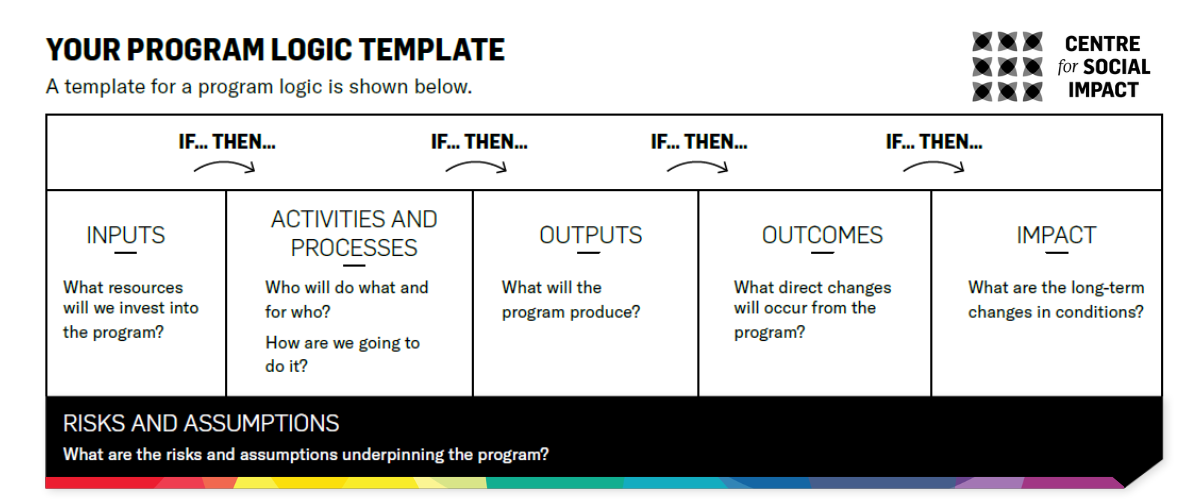
When deciding what to measure organisations should be able to clearly explain how they expect change to occur. The Roadmap to Social Impact outlines tools like theory of change and program logic which set out the relationship between a program’s activities, its intended outcomes, assumptions and other factors that may influence outcomes.
Strong outcome statements help organisations identify what evidence they need. Outcome statements guide the selection of meaningful indicators that measure the changes that a program can realistically be expected to influence, rather than attempting to measure every possible effect. Other important information to collect can include data about who is benefiting (or not) from the program, reflections about the success of the implementation process, information about context that helps to explain the results, or other indicators suited to the purpose. What is measured should reflect the purpose of the social impact measurement work and the decisions that the findings are intended to inform.
More FAQs are on the way
Check back here soon as we continue adding answers to common questions about social impact measurement.
Download the Roadmap to Social Impact guide

Download Webinar Resources
Acknowledgement
The Centre for Social Impact gratefully acknowledges the contributions of Dr Cat Street and Dr Lisette Kaleveld from CSI UWA in developing the content for this FAQ resource.