

From Vision to Impact: How Program Logic Supports Planning, Implementation and Evaluation


Achieving meaningful change requires more than just good intentions—it demands strategic planning, clear communication, and measurable impact. Program Logic provides a structured framework that helps organisations navigate complex initiatives, ensuring resources are effectively allocated and desired outcomes are met. By visually mapping the connections between activities, outputs, and long-term goals, Program Logic enables teams to align their efforts with real-world needs, fostering transparency, accountability, and continuous improvement.
What is Program Logic?
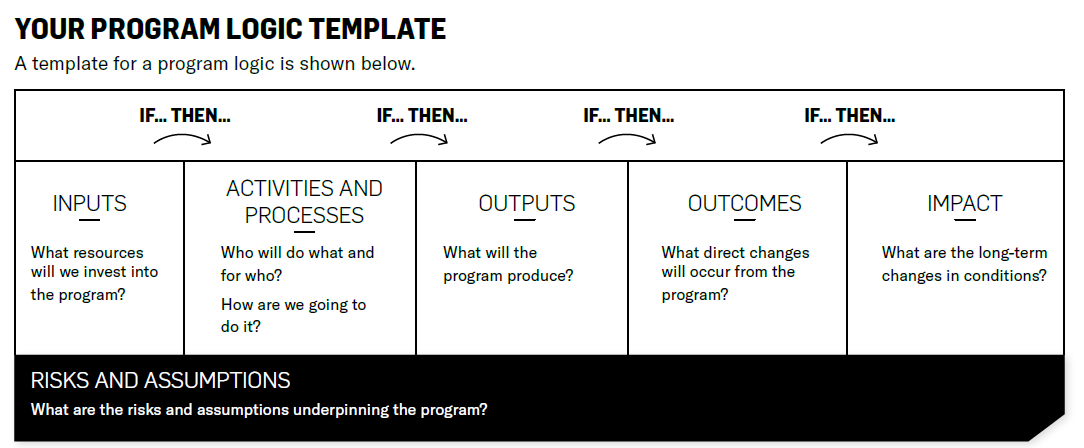
Program Logic is a powerful tool for structuring, evaluating, and communicating the impact of initiatives across various sectors, including government, non-profit, and corporate. It provides a clear framework to define activities, outputs, and expected outcomes, ensuring that all stakeholders understand the purpose and impact of a program.
At its core, Program Logic visually maps how resources and actions lead to intended results. This structured methodology enhances clarity, accountability, and effectiveness in program execution.
“Developing a Program Logic enables us to take a step back and understand not just what we are doing, but why we are doing it. It allows for critical reflection and better decision-making, ensuring programs are aligned with what is actually needed," explains Syarif Abdul-Wahed , Research Fellow at CSI UWA.
The Role of Program Logic in Effective Planning
Program Logic is essential for strategic planning in organisations to outline their goals and the steps required to achieve them. A well-structured Program Logic allows tracking key performance indicators (KPIs) and effectively measuring impact. A visual representation of a Program's Logic enhances communication with funders, policymakers, and internal teams. It ensures efficient use of resources by aligning activities with desired outcomes. Organisations can refine their strategies over time by identifying gaps and testing assumptions.
"The power of Program Logic lies in its ability to turn complex initiatives into clear, structured plans. By engaging stakeholders, including those with lived experience, we create meaningful strategies with greater integrity and buy-in," says Lisette Kaleveld , Senior Research Fellow at CSI UWA.
Best Practices for Applying Program Logic
- Plan before implementation: Use logic models, flowcharts to outline processes before execution.
- Keep it simple and scalable: Avoid unnecessary complexity; design solutions that can adapt to changing needs.
- Utilise data-driven insights: Leverage Program Logic to analyse trends and improve decision-making.
- Engage stakeholders: Ensure that beneficiaries, funders, and team members understand and contribute to the Program Logic.
Program logic: A practical backbone of a Theory of Change
By clearly mapping activities, outputs, and short- to medium-term outcomes, program logic makes explicit how day-to-day actions are expected to lead to change. This structured thinking then feeds into the Theory of Change by connecting those outcomes to broader, long-term impacts and articulating the assumptions behind them. Together, program logic grounds the Theory of Change in reality, ensuring that big-picture aspirations are supported by clear, evidence-informed pathways.
Program Logic for Long-term Success
Mastering Program Logic leads to more successful and transformative outcomes. By adopting modern visualisation techniques and engaging with stakeholders, organisations can create more meaningful, effective programs. This ensures that initiatives are not just well-documented but also strategically aligned with real-world needs, fostering transparency and accountability in program delivery.
WANT TO LEARN MORE?
CSI UWA will deliver a Masterclass on Program Logic on 5 March 2026 and other professional development opportunities throughout the year, in Perth and beyond – find out more about the Social Impact Masterclass series.